The Ultimate Guide to the Big 5 in Kruger National Park
For anyone visiting Kruger National Park, spotting the "Big 5" is often at the ultimate pinnacle of the safari bucket list. Every year, thousands of visitors scan the horizon, binoculars raised, hoping to catch a glimpse of these legendary creatures. But where did this iconic term actually come from? What makes these specific five animals so special compared to the giraffe, cheetah, or hippopotamus?
In this article, we explore the bloody origins of the term, the incredible biological characteristics of each animal, and expert advice on the best regions and roads to find the Big 5 during your Kruger safari.
The Origin & History of the Term "Big 5"
Contrary to popular belief—and to the surprise of many first-time safari-goers—the term "Big 5" was not coined by conservationists, tourism boards, or naturalists to describe the largest, most beautiful, or most endangered animals in Africa. If the list were based purely on size, the hippopotamus and giraffe would easily replace the leopard and lion.
Instead, the moniker has a much darker history. It was originally used by big-game hunters in the late 19th and early 20th centuries during the colonial era. During this time, men like Theodore Roosevelt and Ernest Hemingway famously traveled to Africa on extended hunting expeditions. The term "Big 5" was specifically used to describe the five most difficult and dangerous African animals to hunt on foot.
These five animals shared a terrifying trait for hunters: when cornered, injured, or threatened, they did not flee. Instead, they would charge. A wounded buffalo would circle back through the bush to ambush its pursuer; a leopard would drop silently from a tree without warning; a lion would charge with blinding speed; an elephant would use its immense size and intelligence to crush threats; and a rhino would launch a blind, aggressive assault. For colonial hunters, securing a trophy from each of the Big 5 was considered the ultimate—and most deadly—test of skill and bravery.
The Shift to Conservation
Thankfully, the narrative has drastically shifted over the last century. With the establishment of protected areas—including the founding of the Sabie Game Reserve in 1898, which eventually became Kruger National Park in 1926—the focus shifted from hunting to preservation.
Today, the term has been brilliantly reclaimed by the global tourism and conservation industries. "Shooting" these animals now happens almost exclusively with camera lenses. The modern safari industry relies heavily on the allure of the Big 5 to generate critical funding for anti-poaching units, community upliftment, and habitat preservation. The very term that once celebrated their destruction is now the engine driving their survival.
1. The African Elephant (Loxodonta africana)
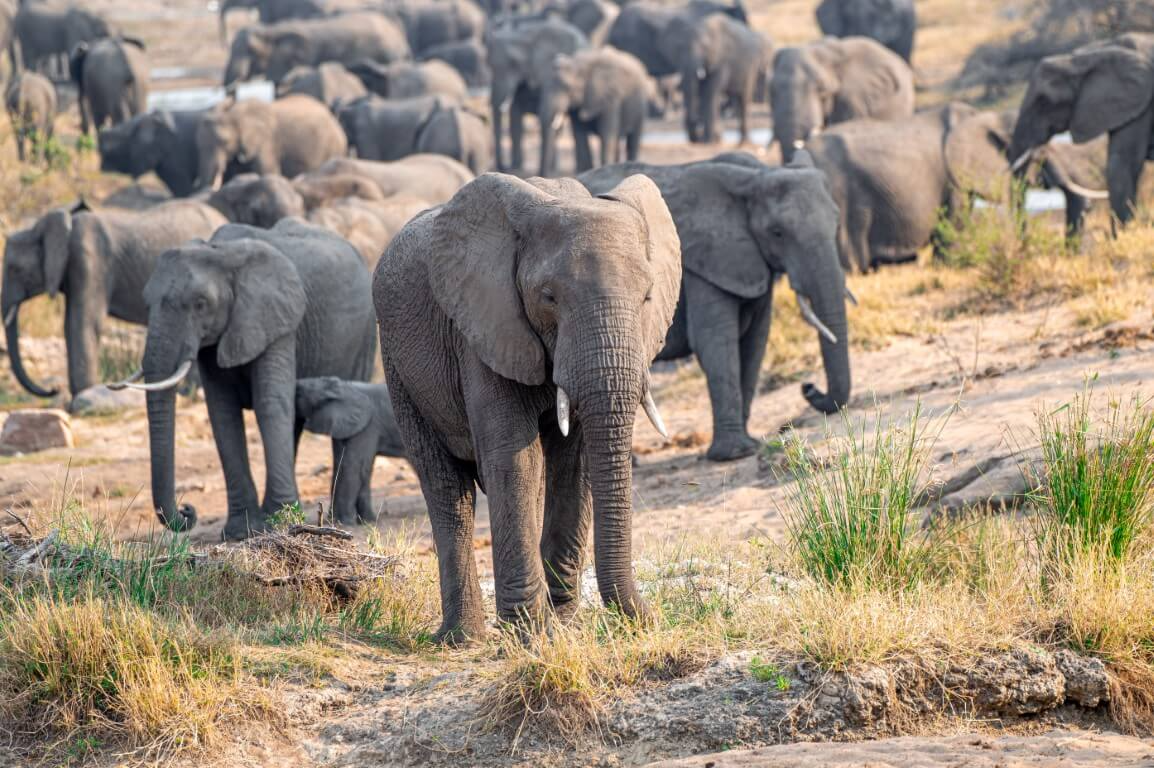
The highly intelligent, ecosystem-engineering gentle giants of the bush.
The African savanna elephant is the undisputed heavyweight champion of the bush, holding the title of the largest living land mammal on Earth. Adult males (bulls) can weigh up to 6,000 kg (13,000 lbs) and stand nearly four meters tall at the shoulder.
But their sheer size is only a fraction of what makes them so extraordinary. Elephants possess hyper-complex social structures and intelligence levels that rival primates and cetaceans. They live in matriarchal herds led by an older, experienced female. The matriarch relies on her incredible, decades-long memory to lead her family to water during severe droughts and navigate ancient migratory routes.
Their social bonds are profound. Elephants have been observed displaying what scientists can only describe as grief—gently touching the bones of deceased relatives and standing vigil over their dead. They communicate over vast distances using low-frequency "infrasound," rumbling at pitches too low for human ears to detect, but which can travel miles through the ground and be felt by other elephants through sensitive cells in their feet.
Ecologically, they are known as "ecosystem engineers." By pushing over dead trees, pulling down high branches, and digging deep holes in dry riverbeds to access subterranean water, elephants literally shape the landscape, creating habitats and water sources that sustain countless other species during the dry winter months.
Best Places to Find Them in Kruger: Elephants are adaptable and can be found in almost every region of the park. However, if you want to see massive breeding herds and iconic "tusker" bulls with ivory that scrapes the ground, you need to head to the Northern and Central regions.
- The expansive mopane woodlands around Letaba, Mopani, and Shingwedzi camps are elephant havens.
- The S50 road along the Shingwedzi River and the H1-6 road north of Letaba are world-renowned for incredible, up-close elephant viewing, especially during the midday heat when herds come down to the riverbeds to drink and bathe in the mud to cool their skin.
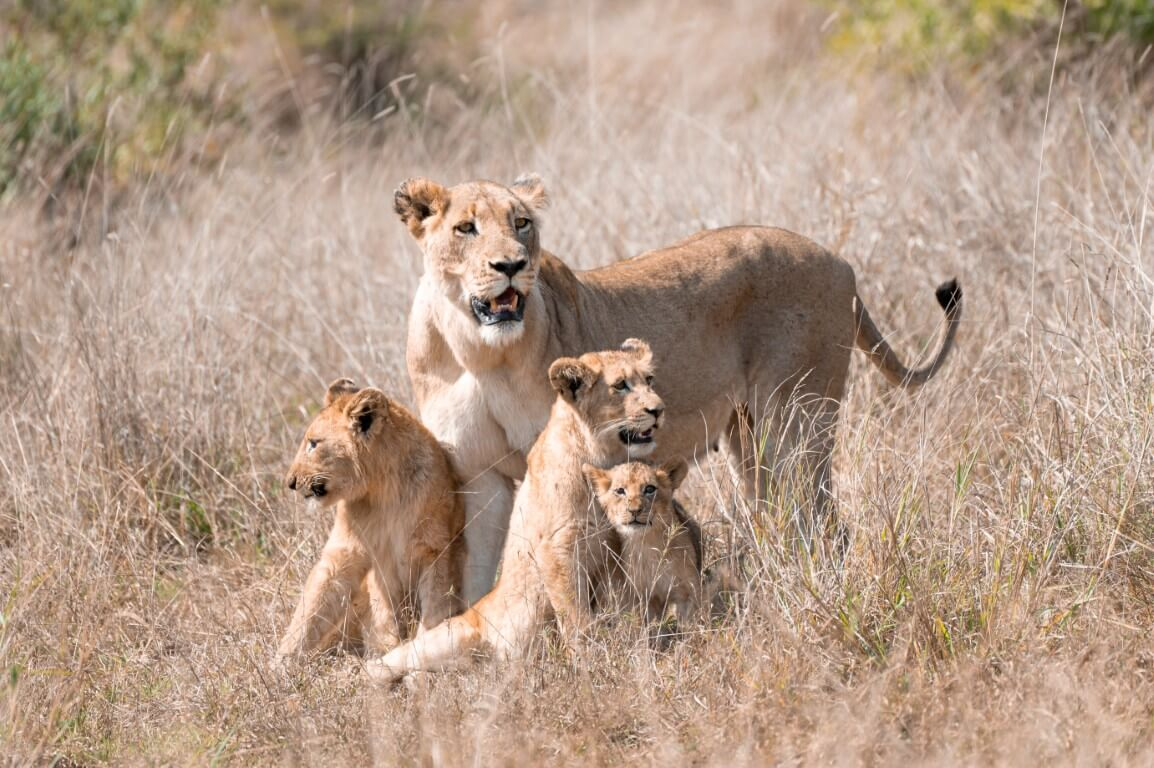
2. The African Lion (Panthera leo)
The fiercely social and undisputed king of the savanna.
No safari is complete without the heart-stopping thrill of encountering a lion. They are entirely unique among the world's wild cats because of their deeply social nature. Unlike the solitary leopard or cheetah, lions live in family units known as prides. A pride typically consists of several related females, their cubs, and a defending coalition of one to four dominant males.
The roar of a male lion is one of the most primal sounds on the planet. It can reach 114 decibels and can be heard up to 8 kilometers (5 miles) away. Hearing this sound reverberate through the walls of your tent or bungalow at night in a Kruger rest camp is an experience that vibrates right through your chest.
Despite their fearsome reputation, lions actually spend up to 20 hours a day sleeping or resting in the shade. This extreme energy conservation is necessary because hunting—which is primarily done by the smaller, faster, and more agile females working in coordinated teams—requires explosive, exhausting bursts of energy. When a massive male coalition takes over a new pride, they will often kill the existing cubs to force the females back into estrus, ensuring their own genetic lines survive. It is a brutal, unapologetic reality of the African wild.
Best Places to Find Them in Kruger: Lions are apex predators that follow the food. They prefer open grasslands and savannas where large herds of their preferred prey—zebra, wildebeest, and buffalo—graze.
- The central plains around Satara Rest Camp are affectionately known as the "Cat Capital" of Kruger.
- The S100 dirt road (N'wanetsi River road) just east of Satara is historically one of the most reliable roads in Africa to spot lions making a kill or resting in the road.
- The H4-1 along the Sabie River near Lower Sabie is another massive hotspot, where lions frequently use the tar road to warm themselves on chilly winter mornings.
3. The Cape Buffalo (Syncerus caffer)
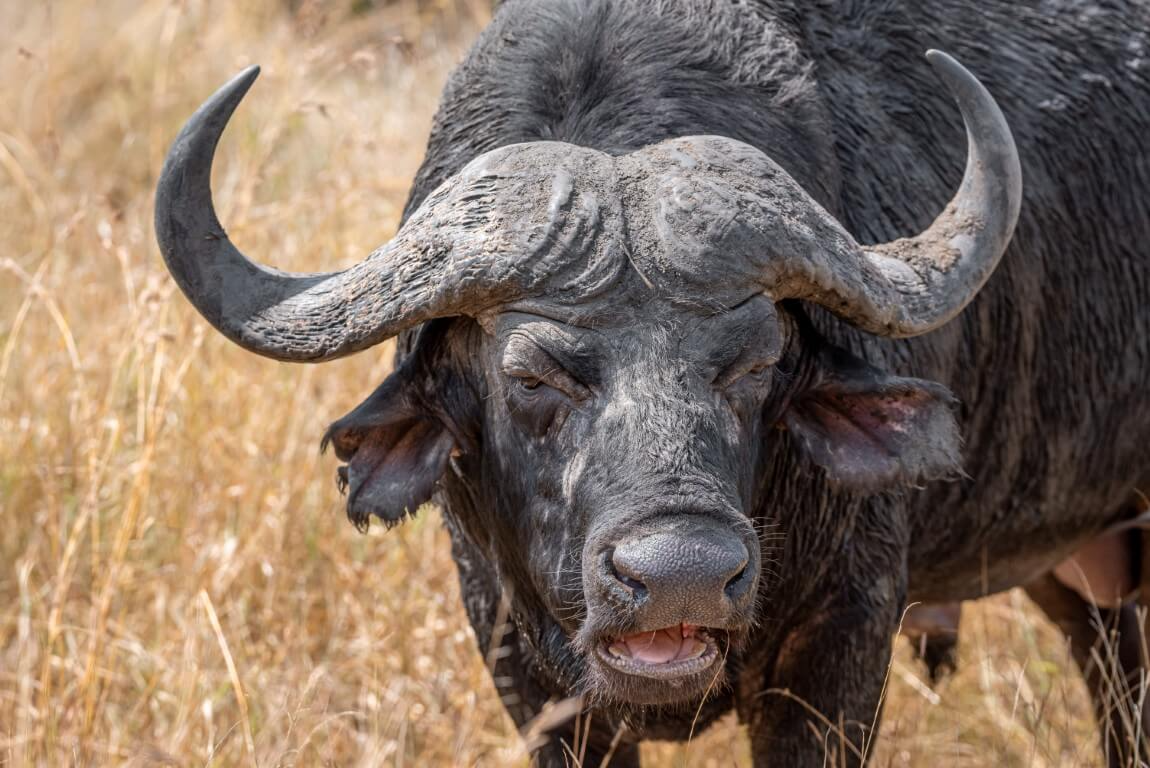
Unpredictable, incredibly resilient, and fiercely protective.
Often described by people who don't know better as looking like ordinary cows, the Cape Buffalo is arguably the most underestimated animal of the Big 5. Ask any seasoned Kruger field guide which animal they fear walking into on foot, and almost all of them will say the buffalo. Nicknamed "The Black Death" by early hunters, they are unpredictable, prone to aggression when agitated, and equipped with a massive fused horn base across their head known as a "boss," which acts like a battering ram.
Buffalo are highly gregarious, living in massive herds that can swell to over a thousand individuals. These mega-herds act as a unified, impenetrable defense system. When threatened by lions—their only real natural predator—they don't scatter. Instead, the adults will form a defensive circle around the calves, facing outward, and will aggressively counter-attack the lions, often trampling or tossing the cats into the air with their horns. The eternal, brutal war between lions and buffalo is a defining feature of the Kruger ecosystem.
Older male buffaloes that are past their breeding prime will often leave the large herds to live solitary lives or form small bachelor groups. These males are affectionately known as "Dagga Boys" (dagga meaning mud in Zulu, referring to their habit of wallowing in mud thickets). Grumpy, isolated, and lacking the protection of the herd, Dagga Boys are the most dangerous and unpredictable of all.
Best Places to Find Them in Kruger: Buffaloes are highly water-dependent and must drink at least once a day, so they rarely stray far from permanent water sources. They also require large amounts of deep, sweet grass to sustain their massive bulk.
- The southern regions of Kruger, particularly along the Crocodile River (S25 road), are superb.
- The area between Crocodile Bridge, Lower Sabie, and Skukuza frequently hosts mega-herds.
- Keep an eye on riverbeds during the late afternoon; watching a herd of 500 buffalo kick up golden dust as they descend to the water to drink is a photographic dream.
4. The Leopard (Panthera pardus)
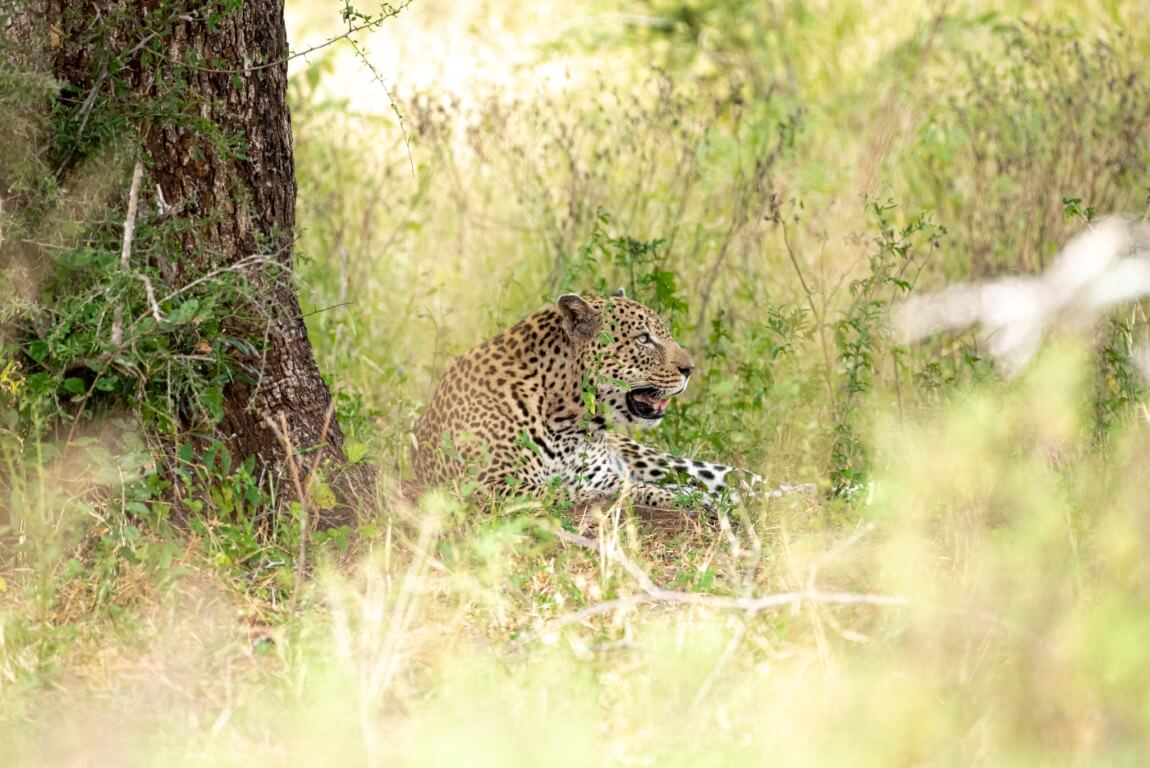
The master of stealth and the elusive phantom of the bush.
For many visitors, the leopard is the holy grail. Stunningly beautiful, completely solitary, and brilliantly camouflaged, spotting a leopard requires a mix of perfect timing, a sharp eye, and sheer luck. Unlike lions, leopards do not announce their presence. They move like ghosts through the dappled shade of the undergrowth.
Leopards are pound-for-pound the strongest of the big cats. They have adapted a unique and incredible survival strategy to deal with larger predators stealing their hard-earned meals: they drag their kills up into the high branches of trees. An adult leopard can haul a dead impala—often weighing more than the leopard itself—straight up a vertical tree trunk using only its powerful jaw and neck muscles.
They are predominantly nocturnal, relying extensively on their exceptional night vision, hearing, and long whiskers to navigate the dark and ambush prey. Females are highly protective mothers, hiding their vulnerable cubs in rocky outcrops (koppies) or dense thickets while they hunt. Because they are highly territorial, if you see a leopard on a specific stretch of road, there is a good chance it "owns" that territory and may be seen there again.
Best Places to Find Them in Kruger: Leopards prefer dense, riverine forests where their rosette spots provide perfect camouflage among the shadows, and where large trees offer refuge.
- The Sabie Sand Game Reserve, which shares an unfenced western border with Kruger, is globally recognized as the best place on Earth to view leopards, as generations of the cats have become incredibly habituated to game drive vehicles.
- Inside Kruger proper, focus heavily on the H4-1 (Skukuza to Lower Sabie) and the S3 (Sabie Sand River Road).
- Drive slowly and constantly scan the V-shaped forks and horizontal branches of massive Jackalberry, Sausage, and Sycamore Fig trees along the riverbanks. Always remember to look up.
5. The Rhinoceros (White & Black)
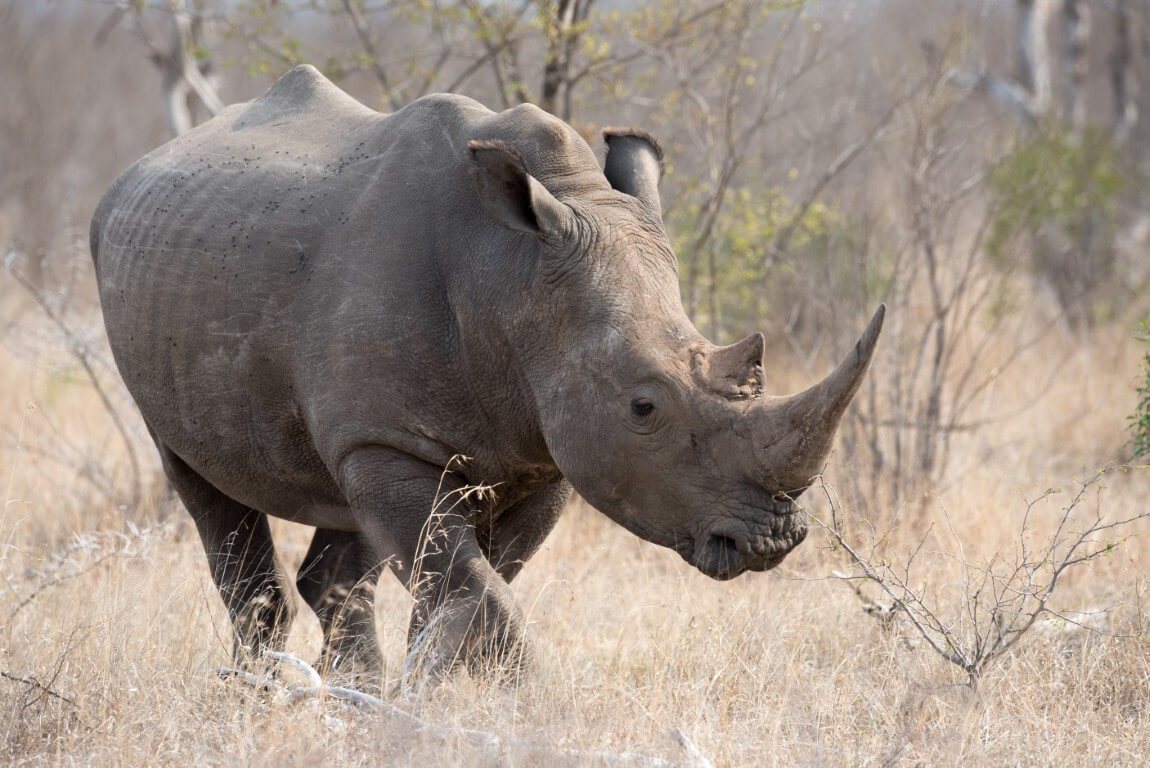
Prehistoric armor and a tragic, heartbreaking vulnerability.
Kruger National Park is one of the last great strongholds for rhinos on the planet, hosting two distinct species: the Southern White Rhino (Ceratotherium simum) and the critically endangered Black Rhino (Diceros bicornis).
The names "white" and "black" have nothing to do with their color—they are both a slate gray. The name "white" is believed to be a mistranslation of the Dutch/Afrikaans word "wyd" (wide), describing the animal's broad, square lips. White rhinos are grazers; they act like massive lawnmowers, eating huge quantities of short grass. They tend to have a more placid, docile temperament, and Calves usually run in front of their mothers.
The Black rhino, by contrast, has a pointed, prehensile upper lip designed to hook and strip leaves and branches from bushes and trees (a browser). They are generally smaller, highly solitary, and notoriously bad-tempered and aggressive. A black rhino calf will predictably run behind its mother.
Tragically, both species have been decimated by a relentless, highly organized poaching crisis driven by international black-market syndicates. Rhino horn is made of keratin—the exact same material as human fingernails and hair—yet it commands astronomical prices in parts of Asia due to scientifically baseless beliefs in its medicinal properties and its use as a status symbol. Kruger’s rangers fight a daily, militarized war to protect the surviving populations, often risking their own lives.
Best Places to Find Them in Kruger: Due directly to the severe poaching threat, Kruger management explicitly asks visitors not to share live locations, GPS coordinates, or time-stamped photos of rhinos on social media or sighting apps.
- Generally, the grassy plains and granite koppies of the extreme south—around Berg-en-Dal, Pretoriuskop, and Malelane—offer the highest density of White Rhinos, as the grass here suits their grazing needs.
- The S114 and S110 dirt loops are historically strong areas.
- Black rhinos prefer thick, impenetrable thornveld to browse in, primarily in the southern and central-western regions. Spotting a black rhino is immensely rare and should be considered a massive privilege.
Expert Tips for a Successful Big 5 Safari
- Patience is Key: The bush is not a zoo, nor is it a sterile documentary set. Some days you might see three of the Big 5 before you've even had breakfast; other days you might drive 100 kilometers and see nothing but impala and dung beetles. Enjoy the quiet moments, the immense landscapes, and the incredible birdlife while you search. The magic is in the unpredictability.
- Timing Matters Immensely: Predators and rhinos are significantly more active in the cooler hours of dawn and dusk. The midday heat (11:00 AM - 3:00 PM) is notoriously quiet, as animals retreat into the deep shade to sleep. Plan your game drives the minute the camp gates open in the morning, or in the late afternoon before sunset.
- Use the Network: Check the physical magnetic sighting boards at the reception areas of every rest camp before you leave. These map out exactly what animals were seen where by other guests that day.
Finally, while seeing the Big 5 is a spectacular, unforgettable milestone, remember to avoid "bucket-list tunnel vision." Stop for the lilac-breasted roller in the tree, watch the dung beetle stubbornly rolling its ball across the tar road, and appreciate the sunset. The true magic of Kruger National Park lies in its vast, interconnected perfection—and every single creature, large or small, is a vital piece of the puzzle.