The Ugly 5: Celebrating the Misfits of Kruger National Park
While the "Big 5" grab all the headlines, grace the brochures, and dominate the wish lists of millions of safari-goers, there is an entirely different group of animals wandering the African savanna that rarely gets the respect they deserve. Enter the "Ugly 5."
This tongue-in-cell, slightly unfair moniker groups together five creatures that, while perhaps lacking the majestic allure of a leopard or the sheer grandeur of an elephant, are absolutely essential to the survival and functioning of the Kruger ecosystem. Where the Big 5 are celebrated for their danger and difficulty to hunt, the Ugly 5 were grouped together simply for their unconventional appearances: the Wildebeest, the Warthog, the Spotted Hyena, the Marabou Stork, and the Lappet-faced Vulture.
In this deep-dive article, we will unpack the fascinating biology, the brilliant evolutionary adaptations, and the often-misunderstood reputations of Africa's most famous misfits, proving that beauty truly is only skin deep.
The Origin of the "Ugly" Label
Unlike the Big 5, which originated from the colonial era's dangerous hunting expeditions, the "Ugly 5" is a relatively modern invention coined by safari guides and the tourism industry. It was essentially created as a humorous counterpoint. Guides realized that guests were becoming too fixated on spotting lions and elephants, completely ignoring other fascinating, highly active animals that crossed their path.
By grouping these strange-looking animals together and giving them a collective title, guides successfully gamified the safari experience for the "underdogs." It encouraged visitors to look closer at the strange, the scavenging, and the bizarre, resulting in a much deeper appreciation for the circle of life. Nature is not a beauty contest—it is an arena of survival where every adaptation, no matter how grotesque it appears to human eyes, serves a brilliant, life-saving purpose.
1. The Blue Wildebeest (Connochaetes taurinus)
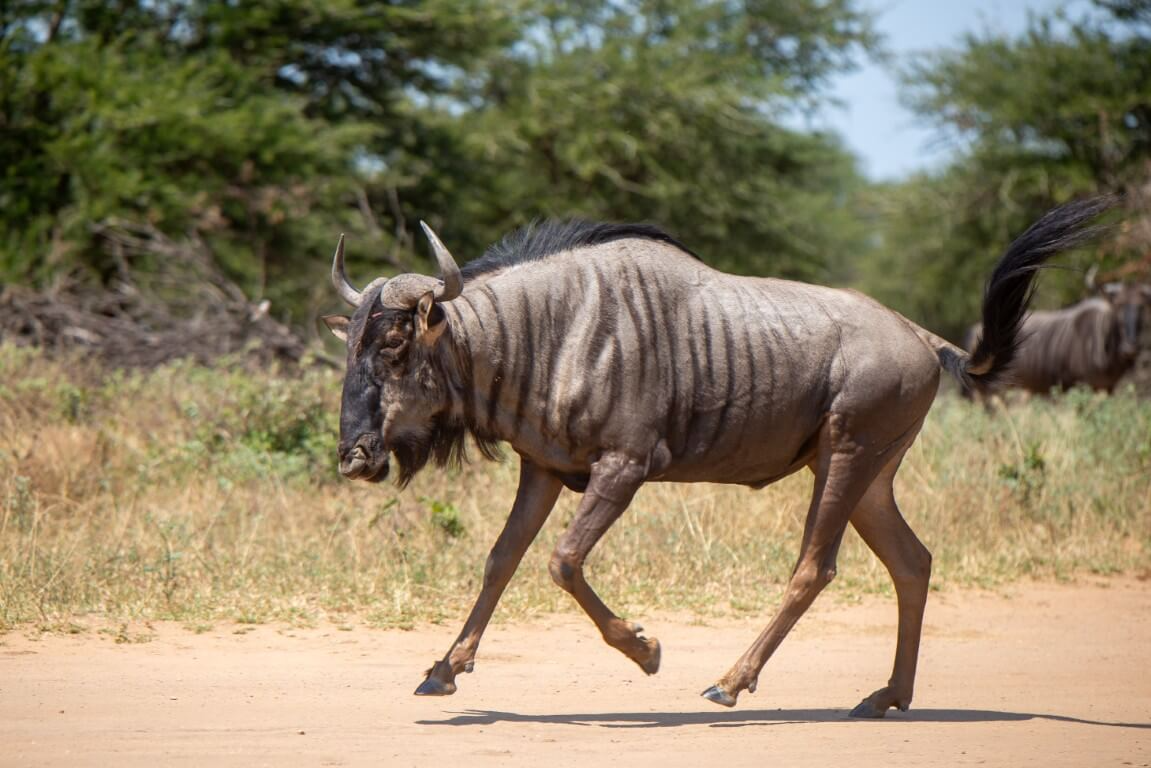
The "spare parts" antelope of the African plains.
Often referred to as the "poor man's buffalo" or described as an animal assembled by a committee from leftover parts, the Blue Wildebeest certainly strikes an odd figure. With the head of a locust, the horns of a cow, the mane of a horse, the body of an ox, and the legs of an antelope, they look front-heavy and perpetually off-balance.
Yet, this bizarre anatomy is a masterpiece of evolutionary engineering. The wildebeest is built for one thing above all: relentless, long-distance movement. Their sloping back and elongated legs give them a highly energy-efficient, loping gait that allows them to cover massive distances in search of fresh grazing and water without exhausting themselves. Their broad, flat muzzles are perfectly designed for bulk-grazing short grasses, making them vital to the maintenance of the open savanna.
Wildebeest are highly gregarious and incredibly vocal. They communicate constantly using deep, honking grunts (hence their Dutch name "wildebeest," meaning wild beast or cattle). During the calving season, up to 90% of females give birth within a synchronized three-week window. This "predator swamping" ensures that although lions and hyenas will inevitably take some calves, the predators quickly become overwhelmed by volume, allowing the vast majority of the young to survive.
Best Places to Find Them in Kruger: Because wildebeest rely entirely on sweet, short grass, they avoid thick woodland and dense bushveld.
- You will find the highest concentrations of wildebeest on the open basalt plains of the central Kruger, particularly around Satara and Orpen.
- The H1-3 (Tshokwane to Satara) and the S100 dirt road are excellent places to spot large herds—often mingling with zebra, as the two species have a symbiotic grazing relationship.
2. The Warthog (Phacochoerus africanus)
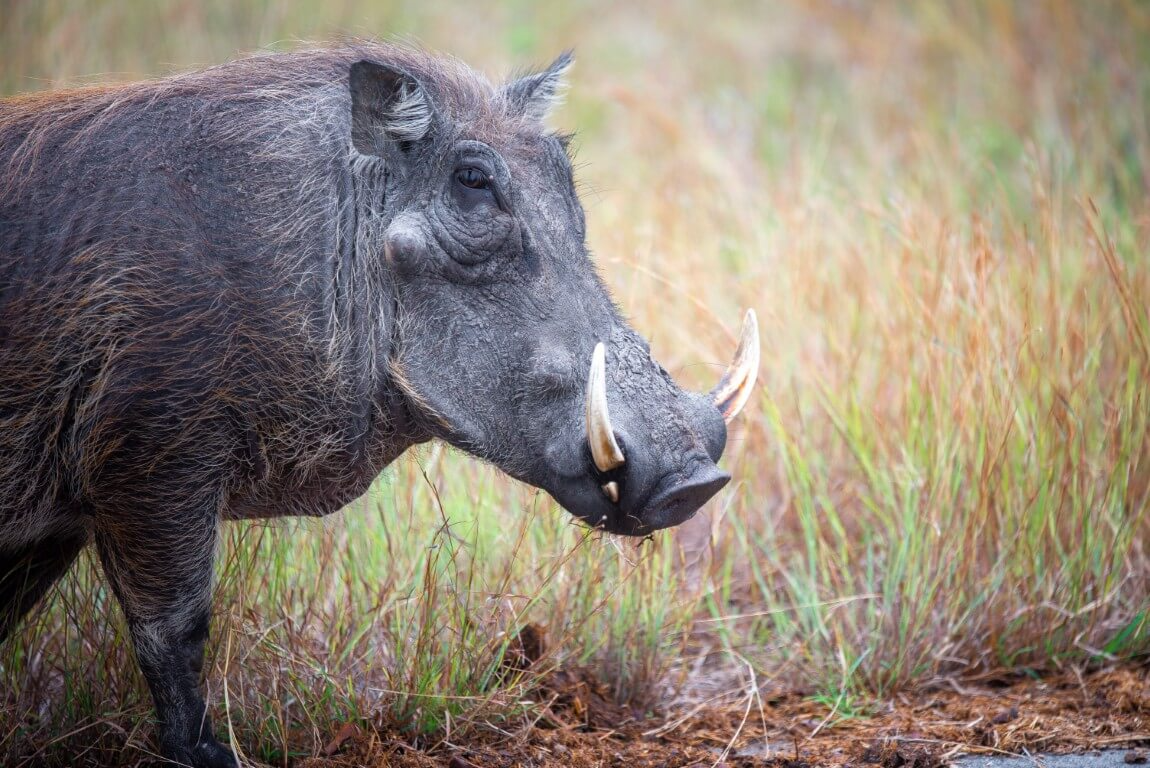
The lovable, kneeling warrior of the bushveld.
With their barrel-like bodies, disproportionately large heads covered in facial "warts," and prominent, curving tusks, warthogs are the undisputed comedians of the savanna. Those famous facial bumps aren't actually warts at all; they are dense, cartilaginous pads designed to protect the animal's face and eyes during violent, head-to-head fights between rival males during mating season.
Warthogs have incredibly poor eyesight, but they compensate with acute hearing and a phenomenal sense of smell. They are the only pigs adapted to grazing on the open savanna. Because they have very short necks and long legs, warthogs must drop to their front "knees" (actually their wrists) in order to feed on short grass or dig for roots using their tough snouts and tusks. To make this comfortable, they have evolved thick, calloused pads on their joints.
One of their most iconic behaviors is how they run: when fleeing danger, their seemingly thin, stringy tails shoot straight up into the air like an antenna. This isn't just a quirk; it acts as a "follow me" flag for their piglets cutting through tall, obscuring grass, ensuring the family stays together during a chaotic sprint away from a predator.
They are also brilliant opportunists when it comes to housing. Warthogs rarely dig their own burrows; instead, they steal the abandoned tunnels of aardvarks. However, they always enter the burrow backwards, keeping their terrifyingly sharp tusks facing the entrance to defend against leopards or wild dogs trying to follow them in.
Best Places to Find Them in Kruger: Warthogs are extremely common and can be seen in almost every region of the park.
- They have a strong affinity for mud wallows, which they use to cool down and rid themselves of ticks. Check the edges of dams and waterholes, particularly in the mid-morning heat.
- You will often see them grazing peacefully right inside the fences of major rest camps like Skukuza and Berg-en-Dal, where they have learned the lawns are safe from lions.
3. The Spotted Hyena (Crocuta crocuta)
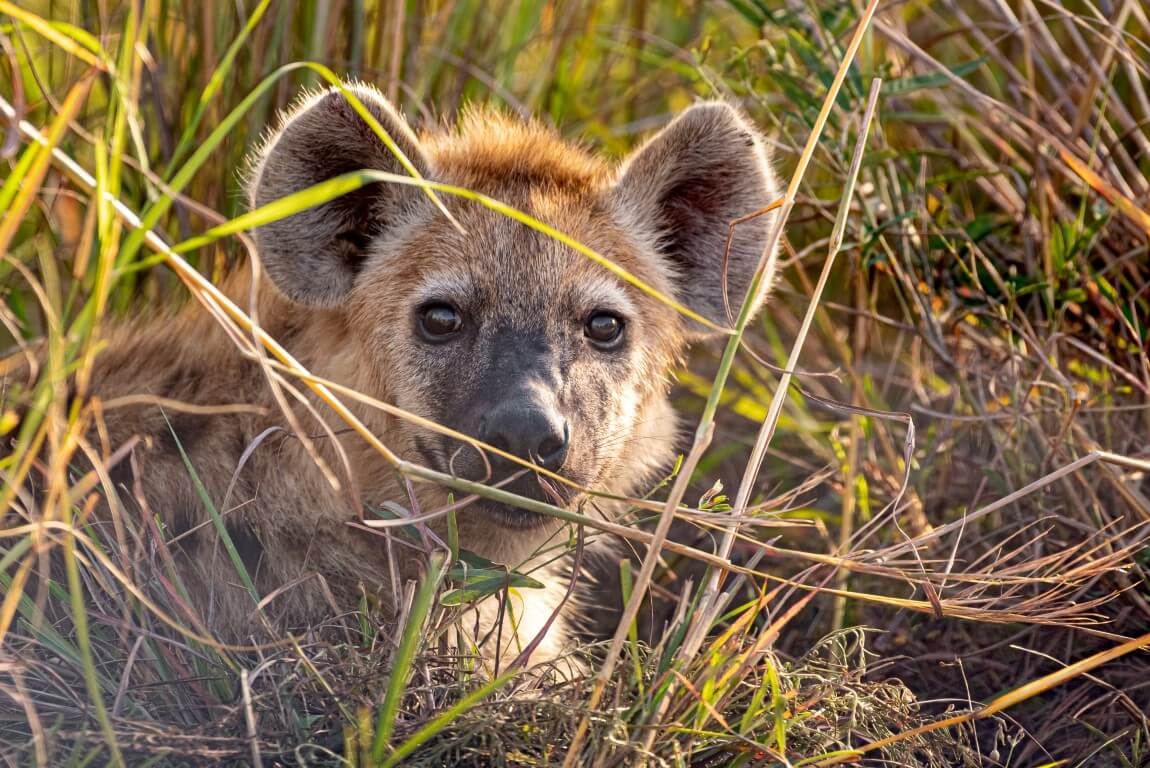
The highly intelligent, matriarchal mastermind of the night.
Perhaps no animal in Africa suffers from a worse PR problem than the Spotted Hyena. Traditionally cast in folklore and popular culture as cowardly, brainless, sneaking scavengers, the reality of the hyena is the exact opposite. They are among the most intelligent, fiercely social, and devastatingly successful apex predators on the continent. In fact, studies show that in many parts of Africa, hyenas actually hunt and kill up to 80% of their own food, and lions scavenge from hyenas far more often than the reverse.
Hyenas belong to a family distinct from both cats and dogs, though they look like strangely proportioned canines. They have massive, powerful necks and jaws that exert a bite force strong enough to crush and consume the thickest femur bones of an elephant or giraffe—bones that no other predator can crack. This allows them to extract bone marrow, a massive source of fat and calories.
Their social structure, the clan, is entirely dominated by females. Female hyenas are larger, significantly more aggressive, and sport elongated genitalia that make them physically indistinguishable from males to the untrained eye. The lowest-ranking female in the clan commands more respect than the highest-ranking male.
And that famous "laugh"? It has nothing to do with humor. The giggling sound is actually a vocalization of extreme stress, anxiety, or submission, usually heard when a lower-ranking hyena is being attacked by a dominant one over a kill, or when the clan is aggressively mobbing a lion to steal meat.
Best Places to Find Them in Kruger: Hyenas are incredibly widespread but are predominantly nocturnal.
- Early morning drives (right as the gates open) are the best time to catch them returning to their dens.
- They are notorious for walking directly down tar roads at night.
- The tar road heading north from Lower Sabie (H4-1) and the roads around Crocodile Bridge frequently have active, multi-generational dens situated in culverts beneath the road itself, offering incredible viewing of the midnight-black pups.
4. The Marabou Stork (Leptoptilos crumenifer)
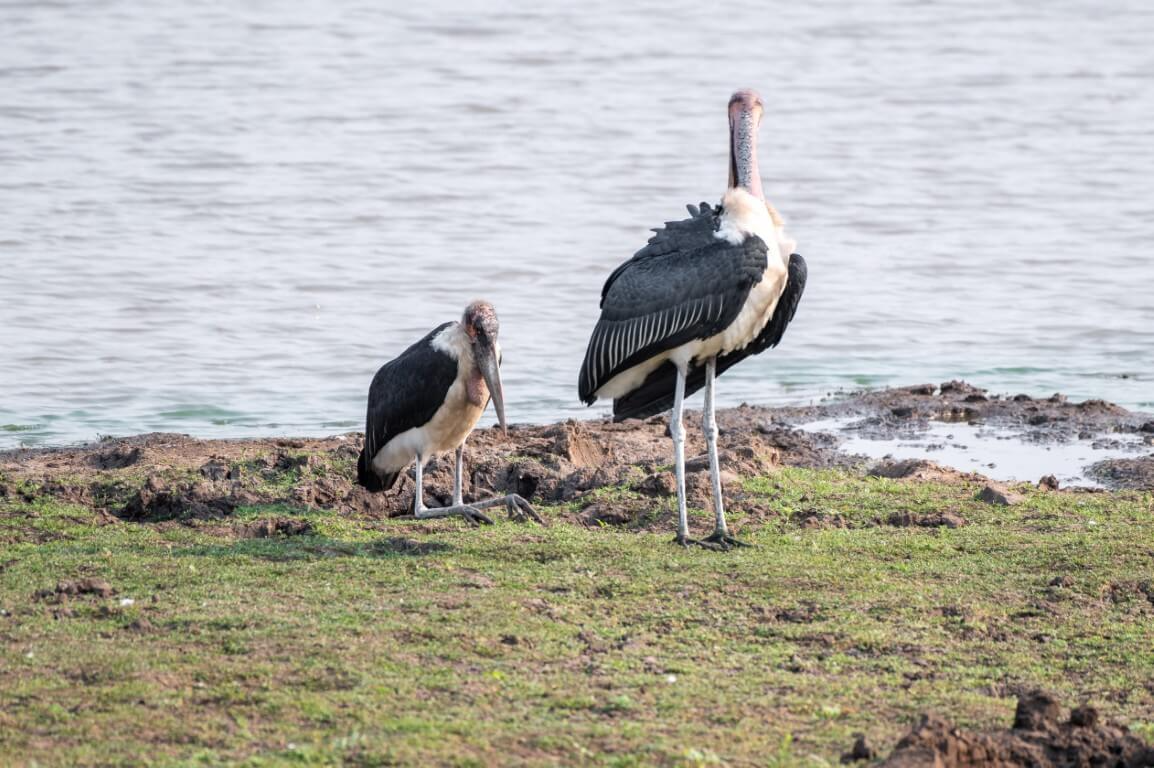
The "undertaker bird" performing a vital civic duty.
It is easy to see why the Marabou Stork made the Ugly 5. Standing up to 1.5 meters (5 feet) tall with a wingspan tying the Andean Condor as one of the largest in the world, the Marabou is a massive, looming presence. It features a stark bald head, a huge, wedge-like bill, and a strange, pinkish, fleshy pouch (a gular sac) dangling from its neck like an unbuttoned shirt collar. Because it is often seen standing hunched over with its wings draped down its sides, it is commonly called the "Undertaker Bird."
However, the Marabou's bizarre appearance is a masterclass in scavenging adaptation. Like a vulture, its scalp is completely bald so that rotting blood and viscera do not stick to feathers and cause dangerous bacterial infections when the bird thrusts its entire head deep inside a rotting carcass. Their massive bills are not used for delicate picking, but as brutal, striking weapons to tear meat and dominate smaller scavengers at a kill site.
The fleshy pouch hanging from the neck is not for storing food, as many believe. Instead, it is used for thermoregulation and is inflated during mating displays to attract females. Marabous are totally indiscriminate eaters—they will consume carrion, swarming locusts, frogs, feces, and even toxic snakes. By consuming and stripping away rotting, diseased meat from the ecosystem, they perform an utterly critical cleanup service that prevents anthrax and botulism from spreading to other animals.
Best Places to Find Them in Kruger: Marabou storks are strongly associated with water and reliable feeding opportunities.
- Look for them around large, permanent water sources like Sunset Dam (near Lower Sabie) or the Letaba River.
- Because they are intelligent opportunists, they will often congregate near large kills made by lions, waiting patiently at the fringes for the big cats to finish so they can move in and clean the bones.
5. The Lappet-faced Vulture (Torgos tracheliotos)
The brutal, necessary enforcer of the scavenging world.
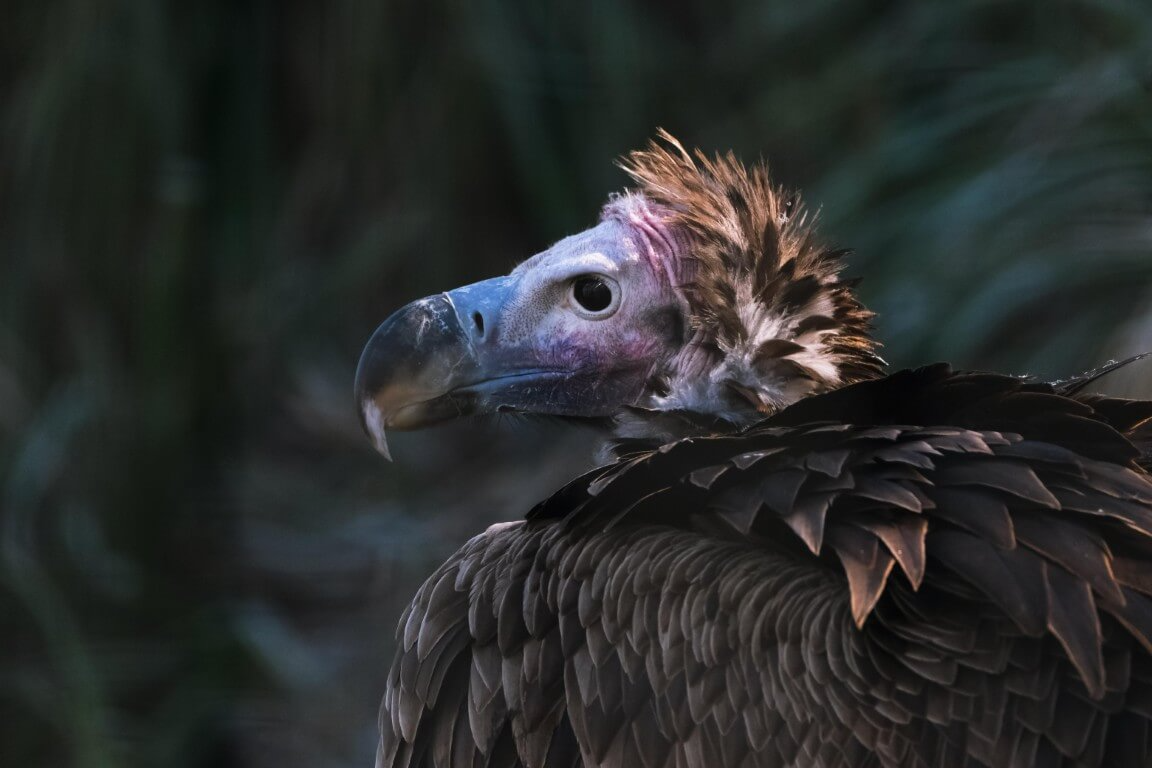
With its massive, wrinkled, pinkish-red head devoid of feathers and dominated by a huge, deeply hooked beak, the Lappet-faced Vulture looks like something out of prehistoric times. It is the largest vulture in Africa and the undeniable boss of any carcass it lands on.
When an animal dies in the bush, thick hides—like those of an elephant, rhino, or buffalo—cannot be penetrated by the smaller, more common White-backed Vultures. They must sit around and wait. When the Lappet-faced Vulture finally drops from the sky, the other birds part like the red sea. The Lappet-faced uses its immense strength and specialized bill specifically to tear through the tough outer hide and rip open tendons, acting as the "can opener" for the rest of the scavenging hierarchy.
These birds do not possess a sense of smell; they rely entirely on eyesight. They soar at high altitudes, watching for the activities of other predators or smaller vulture species dropping down to the ground. Despite their gruesome dining habits, vultures are highly hygienic, bathing in rivers immediately after feeding to clean themselves.
The tragic reality is that all of Africa's vultures, including the Lappet-faced, are facing catastrophic population declines. Poachers intentionally poison carcasses with agricultural pesticides to kill the vultures, because the swirling birds in the sky alert park rangers to the location of a poached rhino or elephant. Protecting these "ugly" birds is now one of the highest conservation priorities on the continent.
Best Places to Find Them in Kruger: Because they cover immense distances on thermal updrafts, they can be seen anywhere in the park where a fresh kill has been made.
- Look up toward the sky during the heat of the midday. If you see dozens of birds circling steadily downward in a tight funnel, there is a very high probability of a lion or leopard kill on the ground exactly beneath them.
- They often nest in the very tops of solitary, flat-topped Acacia trees in the open savannas around Satara and Tshokwane.
Conclusion: Reframing "Ugly"
To call the Wildebeest, Warthog, Hyena, Marabou, and Lappet-faced Vulture "ugly" is to look at them through a deeply human, cosmetic lens. When viewed through the lens of pure survival, ecology, and evolutionary perfection, they are some of the most beautiful creatures on earth. A safari is vastly enriched when you put down the binoculars looking only for lions, and instead take the time to watch a warthog family trot playfully through the grass, or listen to the complex, intelligent calls of a hyena clan organizing their night.